AEO — The New Literacy for Marketers. And It’s Time to Master It.
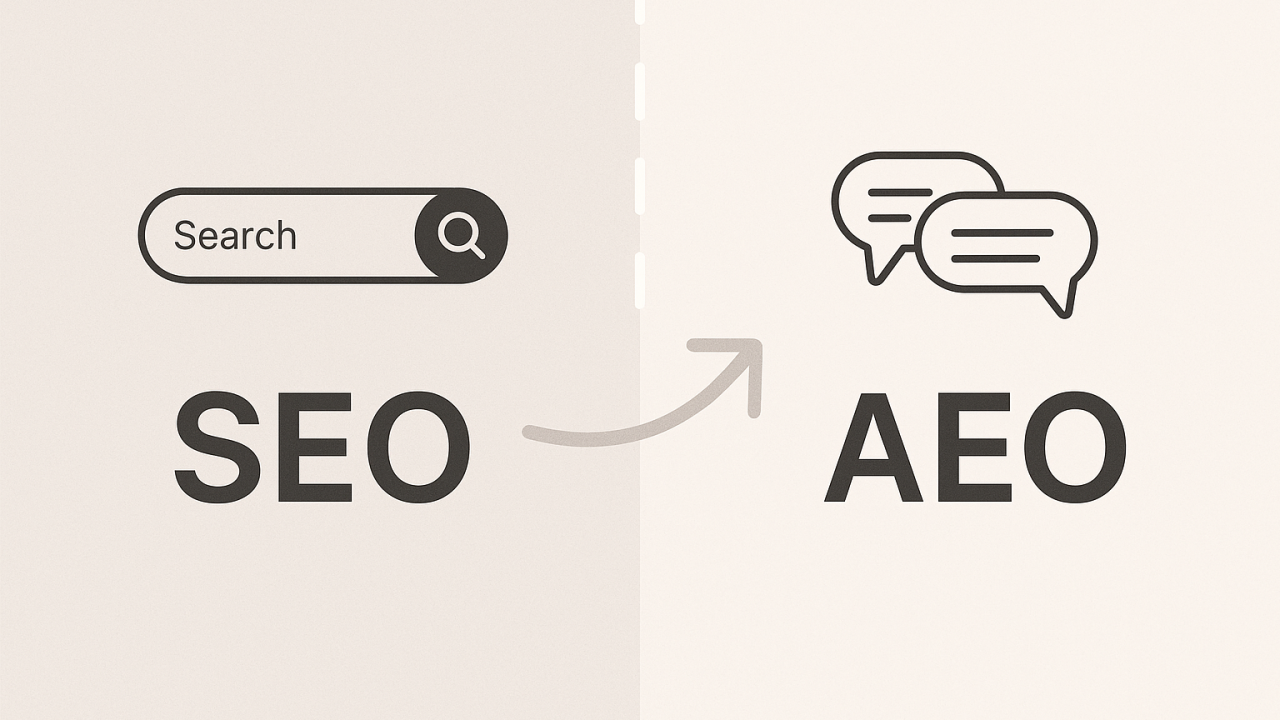
Just recently, SEO-optimization looked like a ruthless race for rankings: optimizing keywords, links, meta-tags, ranking. But today — all that works weaker and weaker. Why? Because the top lines of search results no longer lead to a website — there’s a ready answer from a neural network: concise, on-topic, with no need to click.
Systems like Google Gemini, ChatGPT, and their “answer blocks” (for example, Google AI Overviews) now close the query completely. The traditional “search result list” loses its meaning, because the user receives the answer right away — without a click.
So now it matters not just being in the top-5 — it matters being the one the AI chooses for its answer. That means reworking content so that it’s visible not to the human who searches, but to the machine that answers. This is the beginning of a new era: not SEO, but AEO / GEO (Generative/AI Engine Optimization).
How AI Really Chooses Sources
AI doesn’t “rank” links as a classic search engine. It synthesizes an answer, choosing those sources that most fully, structurally and convincingly reveal the topic. There are several factors that really matter:
- Semantic density: how deeply and thoroughly the topic is covered. If the text is superficial — the model may simply ignore it.
- Predictive coherence: how well content “fits” into a predictable ideal answer structure (problem → context → structure → conclusions → recommendations).
- Authority pattern: not domain’s authority, but the style of authoritative exposition: references to studies, concrete numbers, evidence-based arguments. Models prefer “textbook-style” content.
- Multimodal grounding: content with diagrams, charts, or other visual elements is better understood — so AI will more often use such sources.
- Structured metadata: tables, lists, bullet points, clear headings and subheadings. Not for SEO, but because well-structured text is easier for AI to parse.
- Model checksum patterns: the model checks whether the content matches its “internal knowledge.” If the text contradicts what the model knows — it might be excluded altogether.
It seems as if the AI “reads” not with eyes, but with meaning: it chooses not just the text, but semantic density, structure, depth, arguments, context.
10 practical principles of AEO: how to write content that neural networks will choose as a basis
- Structure “as for an answer.” Write as if AI itself were answering the query: pose a problem → explain the context → give details/facts → recommendations/conclusions.
- Depth, not superficiality. “Top-10 tips” style no longer works. Better: deep dive into the topic — more context, causes, nuances, explanations.
- Content as a manual/guide. Include definitions, terms, frameworks, tables, schemas where relevant — everything that makes the text a practical “tool.”
- Minimal marketing fluff — maximum meaning. AI does not value pomp, excessive emotion or clichés. It values clear, factual, logical tone.
- Evidence: numbers, studies, references. Cite sources, data, research — this boosts “trustworthiness.” AI tends to prefer what looks like fact, not just opinion.
- Semantic depth — covering layers of meaning. It’s not enough only to mention keywords: you should explain mechanisms, metrics, risks, variations, context of use — so AI can “build” from this a full-fledged answer.
- Fragmentation + wholeness. Text may be long, but it should be split into logical blocks — so AI can easily “take out” the needed parts.
- Different formulations — the same idea. Use synonyms, alternative formulations, different structures — this increases the chances that AI will “see” your idea even if the query is slightly different.
- Multimodality, visuals, diagrams. If format allows — add images, graphs, diagrams, tables. AI (especially multimodal) prefers when info isn't only textual.
- Originality: ideas, format, context. Simple rewriting of what’s already been done many times reduces chances to be chosen.
Conclusion
AEO is only emerging, and the rules will evolve as models evolve. But moving away from the old SEO is hardly avoidable. We’re already seeing traffic decline for sites relying solely on classic SEO. From a user’s perspective, content optimized for AI reads much better than a random SEO-article from the past decade.